A sustainable food innovation using low-methoxyl pectin and inulin
Reduced-fat yogurt can lose firmness and release more whey when milk fat is reduced. Researchers at Van Hien University investigated whether pectin recovered from durian rind, combined with inulin, could restore texture while creating value from fruit-processing waste.
Turning Durian Waste into a Functional Ingredient
Durian processing generates a large amount of rind, yet the white inner layer is rich in pectin, a natural polysaccharide widely used as a gelling and stabilizing agent. In this study, Ri6 durian rind was cleaned, dried, milled and extracted with citric acid, followed by ethanol precipitation. The process produced approximately 22.8% pectin on a dry-weight basis. Chemical characterization identified the material as low-methoxyl pectin (LMP), with a degree of esterification of 44.92% and an anhydrouronic acid content of 76.26%.
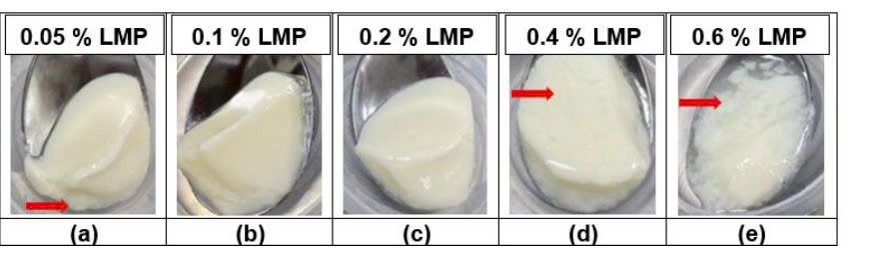
Figure 2. Reduced-fat yogurt containing 2% inulin and different concentrations of durian-rind LMP. At higher LMP levels, visible cracking and whey separation increased.
Low-methoxyl pectin can form networks in the presence of calcium ions, making it particularly useful in fermented dairy systems. The researchers paired LMP with inulin, a dietary fiber and prebiotic ingredient that can contribute to viscosity, water retention and mouthfeel.
A Small Amount of Pectin Makes a Big Difference
The study tested LMP concentrations from 0.05% to 0.60%. The key result was that more pectin did not necessarily produce better yogurt. At 0.10% LMP, firmness increased to 0.62 N, compared with 0.35 N in the untreated reduced-fat yogurt and 0.65 N in the full-fat control. Whey separation also fell from 38.1% in the reduced-fat control to 28.5%.
At moderate concentrations, LMP helped build a cohesive gel. At higher concentrations, however, the matrix became overly dense and less flexible, which promoted whey release. Sensory results followed the same pattern: samples containing 0.05-0.20% LMP received high texture scores, while 0.60% produced a brittle, non-elastic gel. Overall, 0.10% LMP gave the best balance of firmness, water retention and sensory quality.
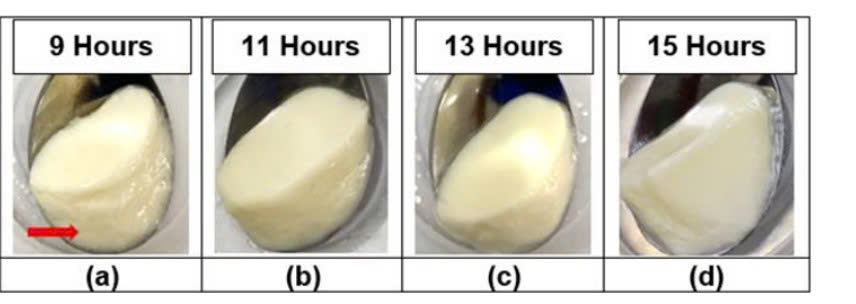
Figure 3. Yogurt containing 2% inulin and 0.10% LMP after 9, 11, 13 and 15 hours of fermentation. Whey release is most visible at 9 hours and decreases as the gel becomes more cohesive.
Inulin Further Improves Reduced-Fat Yogurt
Using 0.10% LMP as the selected pectin level, the researchers then tested 0.5-3.0% inulin. The formulation containing 2.0% inulin + 0.10% LMP showed the strongest overall performance: firmness reached approximately 0.62 N and syneresis was 29.1%. Raising inulin to 3.0% did not provide an additional benefit and slightly increased whey separation to 31.9%. Importantly, the additions did not significantly alter final pH or soluble-solids content.
Fermentation Time Is Just as Important
The optimized formulation was fermented for 9, 11, 13 and 15 hours at 40°C. As fermentation continued, acidity increased, the gel strengthened and whey separation decreased. Firmness rose from 0.27 N at 9 hours to 0.62 N at 15 hours, while syneresis dropped from 35.6% to 29.1%. The pH decreased from 4.17 to 3.84 over the same period.
The study identified 13-15 hours as the most effective fermentation window under the experimental conditions. The photographs support the instrumental measurements: later samples show smoother surfaces and less visible whey release.
Food Innovation with a Circular-Economy Perspective
Taken together, the results point to a promising formulation containing 0.10% durian-rind LMP and 2.0% inulin. This combination restored the firmness of reduced-fat yogurt to a level close to full-fat yogurt and substantially reduced whey separation, while maintaining acceptable flavor and texture.
The value of the work extends beyond yogurt formulation. Durian rind, commonly treated as a processing residue, can be converted into a functional food ingredient. This creates a potential route to reduce waste, increase the value of agricultural by-products and support the development of lower-fat, fiber-enriched dairy products.
Key takeaway: Combining durian-rind pectin, inulin and controlled fermentation offers a practical example of how food science can connect healthier product development with waste valorization and the circular bioeconomy.
Source: Pham, L. T. H. & Tran, U. P. N. (2025). Enhancing the Texture and Stability of Low-Fat Yogurt Using Inulin and Durian Rind-Derived Low-Methoxyl Pectin. Chemical Engineering Transactions, 122, 217-222. DOI: 10.3303/CET25122037.